
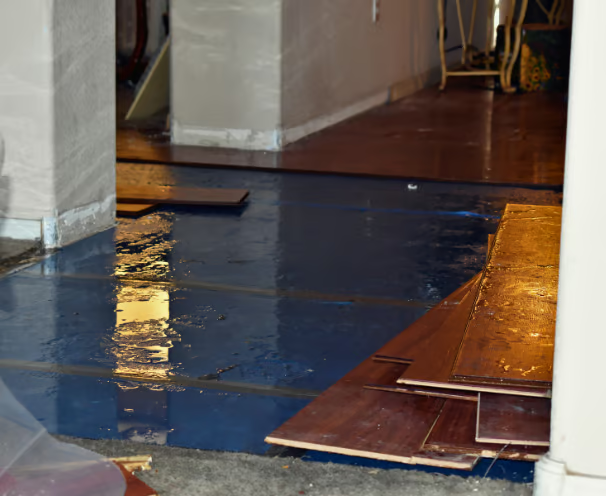
Here is a surprise that catches homeowners every year: two houses on the same street can have identical wet basements and get opposite answers from their insurers. The difference is not the damage. It is the definition. In insurance language, "water damage" and "flood damage" are different events, covered by different policies, and knowing which one you are dealing with shapes everything from your first phone call to what gets paid.
This article is general information about how homeowners insurance usually works in the United States — not advice about your specific policy. Your policy documents and your insurer are the final word on your coverage.
The usual line: where the water came from
Standard homeowners policies generally cover water damage that is sudden, accidental, and internal — water that escapes from inside the home's systems. The classic examples:
- A burst or frozen pipe
- A ruptured water heater or appliance supply line
- An overflowing washing machine or dishwasher
- Rain that enters through a roof opening created by a covered event, like a storm tearing off shingles
Flood damage, by contrast, usually means water that comes from outside and at ground level: rising rivers and lakes, storm surge, heavy rain that pools and flows over land into multiple properties, or mudflow. Standard homeowners policies generally do not cover flood. Flood coverage is typically a separate policy, most often through the National Flood Insurance Program (NFIP) or a private flood insurer — and it usually has a waiting period (commonly 30 days) before it takes effect, so it cannot be bought when the storm is already on the radar.
The gray areas Minnesota homeowners actually hit
- Sump pump failure and sewer backup. When a sump pump fails during a storm, or a sewer or drain backs up into the basement, standard policies often exclude it — but many insurers offer a specific endorsement (sometimes called water backup coverage) that adds it back, usually with its own limit. In a state with as many finished basements as Minnesota, this endorsement is one of the most commonly relevant lines in the whole policy.
- Groundwater seepage. Water that seeps through foundation walls or floors over time is usually treated as a maintenance issue, not a covered event.
- Slow leaks. A pipe that has been dripping inside a wall for months is the classic denial: coverage typically applies to sudden events, and insurers often exclude damage from long-term leaks that reasonable maintenance would have caught.
- Ice dam leaks. Water entering through a roof because of an ice dam is often treated under the water damage side of the line — but policies vary, and the roof damage itself and the interior damage may be treated differently. This is one to ask your insurer about specifically.
What this means in the first hours of a loss
You do not need to resolve the definitions before acting. In fact, policies generally require you to take reasonable steps to prevent further damage — stopping the water, extracting, and drying — regardless of how the claim is ultimately classified. Do document as if the definitions matter, because they do: photograph where the water came from, keep the failed pipe or part if one exists, note the timeline, and save every receipt. The source of the water is the single most important fact in the claim, and it is easiest to prove on day one.
The takeaway
Think of it as three buckets: sudden internal water events (usually homeowners policy), rising outside water (usually flood policy), and backups and seepage (usually endorsements or exclusions). A yearly ten-minute review — Do I have water backup coverage? Would I need flood coverage where I live? What is my deductible for water claims? — is worth more than any argument after a loss. And when water does come in, fast mitigation protects your home under every definition.